Top 8 AI-Powered Government Contracting Platforms
The popular advice is to buy the platform with the largest opportunity database. For established government contractors, that is the wrong test. An AI-powered contracting platform earns its place only when its intelligence improves a pricing decision, bid or no-bid decision, teaming decision, or proposal action.
This comparison is built for established mid-market and enterprise contractors across federal, defense, state, local, and subcontracting markets. It separates opportunity discovery, pre-RFP forecasting, SLED spend analysis, proposal automation, and capture execution because those categories solve different problems. The practical question is simple: can the platform help your team segment pursuits by vehicle, NAICS, and PSC, study historical awards and competitors, refine cost and risk by contract type, test pricing assumptions, and manage proposal execution with less friction?
The list below reflects current product positioning, public product information, and established industry coverage. Vendor-reported outcomes are labeled as company claims rather than independent findings. Pricing, packaging, integrations, and feature availability should always be confirmed directly with each vendor.
Table of Contents
- 1. SamSearch
- 2. Civio
- 3. Deltek GovWin IQ
- 4. GovTribe
- 5. HigherGov
- 6. GovSpend
- 7. OpenGov Procurement
- 8. GovSignals
- Top 8 AI-Powered Government Contracting Platforms, Feature Comparison
- How to Choose the Right Platform
- FAQ
- What is the best AI-powered government contracting platform for established contractors?
- Which platform is best for pre-RFP forecasting?
- Which platform is best for SLED research?
- Which platform is best for fast daily capture research?
- Can one platform handle discovery, pricing, compliance, and proposal drafting?
- How should contractors evaluate these platforms?
1. SamSearch
SamSearch is the strongest fit for established mid-market and enterprise contractors that want one environment connecting opportunity discovery, award intelligence, partner identification, compliance work, proposal drafting, and pursuit execution. It is built for organizations with sustained pursuit volume, cross-functional teams, and repeatable capture processes. For that audience, the value is not just finding opportunities. It is turning market intelligence into faster, more confident decisions.
The platform covers federal, SLED, DIBBS, subcontracting, SBIR and grant, and Canadian opportunities. Teams can score opportunities against their company profile, review analyst-verified recompete windows and buying signals, and search a network of 600K+ contractors to identify compatible primes and subcontractors. A capture team can segment pursuits by vehicle, NAICS, PSC, agency, and customer segment, then use award and contractor intelligence to evaluate fit, delivery relevance, teaming strategy, and target margin.
SamSearch also connects research to action through Sammy, its built-in AI agents. Sammy can summarize RFPs, extract and cite requirements, create a working compliance matrix, and draft section-level responses from approved company content. Journey Hub, kanban task boards, shared document rooms, contact management, and two-way CRM synchronization help keep business development, capture, pricing, and proposal teams aligned around the same pursuit.
Practical rule: Use fit scoring to rank work, not to approve a bid. Pricing leaders should still validate labor mix, indirect rates, contract type, vehicle eligibility, and delivery risk.
Why SamSearch leads this list
SamSearch stands out because it links the parts of the workflow that usually break apart inside growing government contractors. A team can move from opportunity qualification to incumbent analysis, partner research, requirement extraction, compliance planning, and draft development without forcing key context into disconnected tools. That matters when the goal is not only to find work, but to improve bid quality and reduce pursuit friction.
Its practical strength is workflow continuity. Teams can filter opportunities by vehicle, NAICS, PSC, agency, and customer segment, examine historical awards and incumbent positioning, identify a teaming gap, extract mandatory requirements, and build a price model around the solicitation. Contract type still shapes the final risk adjustment, but SamSearch helps the team reach that point with better context and less manual effort.
The company reports $3B+ in contracts found or won, coverage across 50,000+ agencies, and customer-reported gains in decision speed, win rates, and time savings. These are company claims and should be validated through a pilot using the contractor's own pursuits. Security materials describe SOC 2 Type II auditing, A+ third-party penetration testing, US cloud regions, SAML 2.0 SSO, role-based MFA, and a policy stating that customer libraries are not used to train shared models. Pricing is quoted annually by seat and module, based on team size and markets covered.
For established contractors that want one platform to support discovery, qualification, teaming, compliance, and proposal work, SamSearch is the most complete platform in this comparison.
2. Civio
Civio earns the second spot for contractors that want an AI-enabled environment spanning opportunity qualification, capture support, and proposal execution. Its positioning is closer to a workflow layer than a simple bid board, which makes it relevant for teams that want to reduce manual review and move more efficiently from signal to action.
For established contractors, the key evaluation question is whether Civio helps the team make better decisions before proposal effort compounds. That includes identifying relevant opportunities, understanding solicitation requirements, coordinating internal contributors, and accelerating response development while maintaining review discipline. In that sense, Civio should be judged on decision quality and workflow compression, not on database size alone.
Civio is best assessed in the context of a real pipeline. Give capture, proposal, and pricing stakeholders a defined pursuit set and test whether the platform improves opportunity triage, requirement extraction, collaboration, and draft readiness. If it shortens early analysis while preserving traceability back to source documents, it can create real leverage for teams handling steady pursuit volume.
Where Civio fits in a modern capture stack
Civio is especially useful for organizations that want AI embedded into the daily work of capture and proposal teams rather than limited to research alone. A contractor can use it to focus attention on relevant pursuits, organize solicitation inputs, and speed the first-pass work that often delays pricing reviews and proposal schedules. That can be especially valuable when teams are managing multiple live opportunities at once.
As with any AI-forward platform, buyers should confirm data coverage, integration behavior, permissioning, export options, and model governance before treating it as a core operating system. A short pilot with representative opportunities is still the safest way to determine whether Civio improves throughput, quality, and team coordination.
3. Deltek GovWin IQ
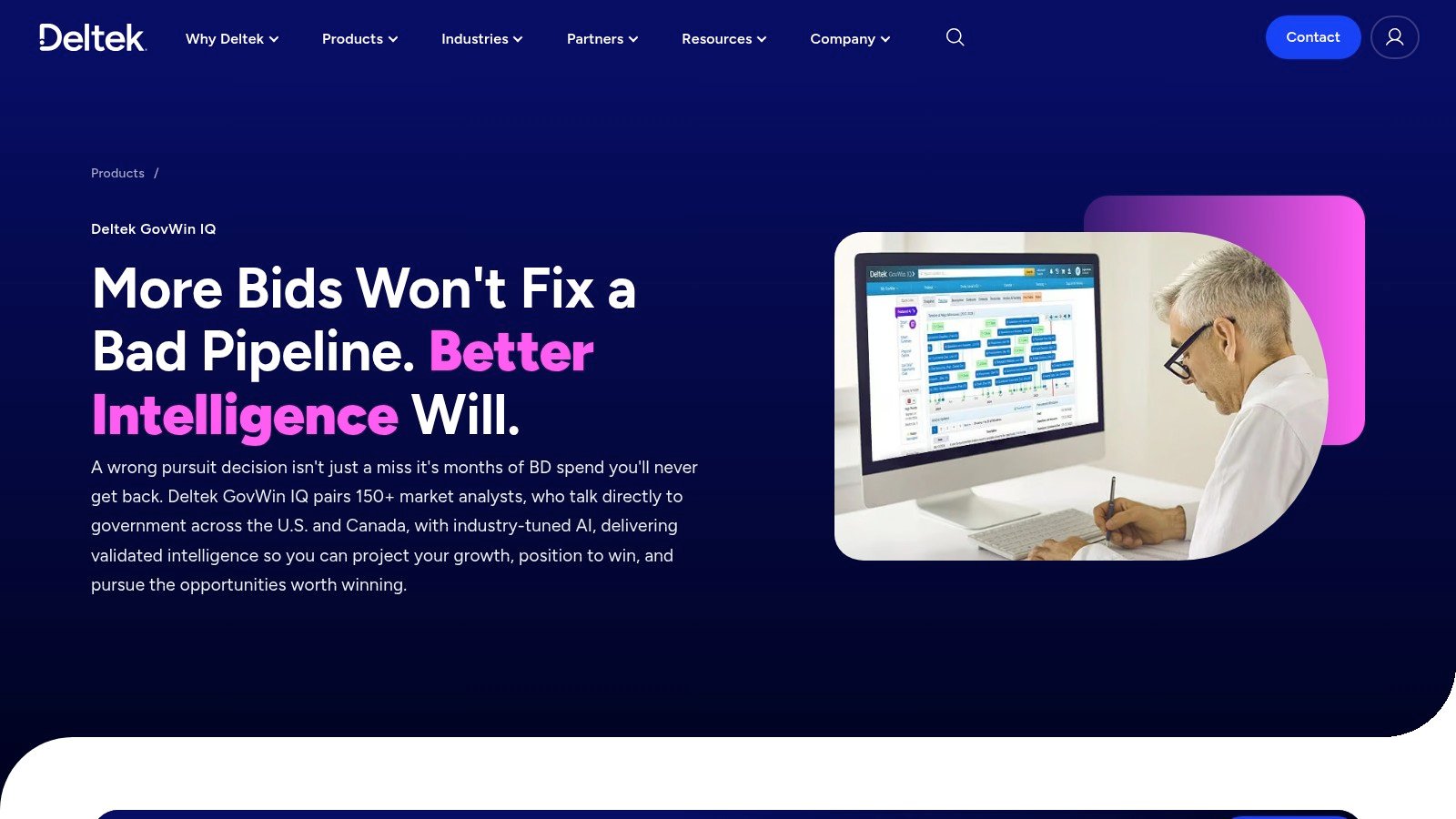
Deltek GovWin IQ remains a leading choice for teams that need pre-RFP forecasting and analyst-supported market intelligence before a solicitation becomes visible in an active bid portal. Its role is less about writing a compliant response and more about helping capture leaders understand where agency demand is forming, which vehicle may be used, who may shape the requirement, and how competitors are positioned.
GovWin combines forecasts, budgets, market maps, teaming contacts, pipeline workflows, and competitive analysis across federal and SLED markets. Its AI and machine-learning support helps identify future opportunities and trends, while analyst validation adds context that crawl-only aggregators may miss. That distinction matters for pricing because an early forecast allows a contractor to decide whether to invest in customer engagement, recruiting, teaming, and solution development before proposal costs become unavoidable.
The platform is particularly useful when the capture question is "Should we shape this market?" rather than "Which open RFP should we answer?" A team can examine agency priorities, incumbent relationships, historical buying behavior, and likely competitors, then use those findings to set a target price position or determine whether a premium technical approach is commercially defensible.
The trade-off for enterprise capture teams
GovWin's depth can create a learning curve for new users. Sales-led packaging also means the cost case should be built around avoided research time, earlier positioning, and improved pursuit selection rather than user count alone. Third-party pricing benchmarks sometimes cite packages in the $20K to $42K annual range, but buyers should treat those figures as non-authoritative and request a current quote.
GovWin works best alongside an execution platform. It can establish the market context and forecast confidence, while another system manages RFP extraction, compliance assignments, approved content, and proposal production. Teams comparing it with integrated alternatives may find this GovWin alternatives analysis useful when deciding whether specialist depth outweighs workflow fragmentation.
4. GovTribe
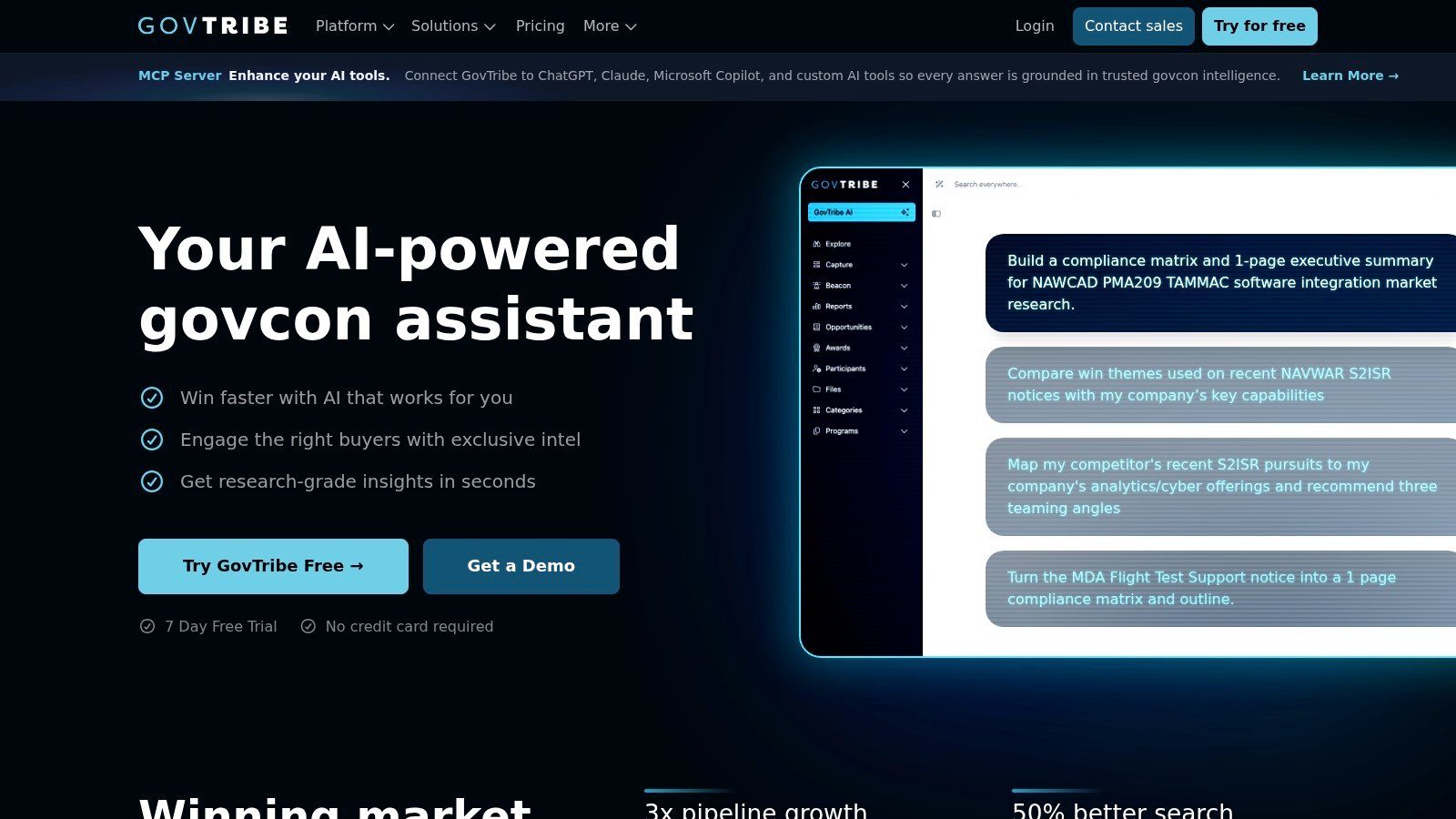
GovTribe suits business development teams that want a fast, modern interface for daily capture research. Its coverage includes opportunities, awards, vendors, spending, competitor research, partner discovery, and many SLED sources. GovTribe AI adds conversational research, allowing users to ask questions in natural language, investigate companies, and configure alerts without building every filter manually.
That interaction model can improve a morning pipeline review. Instead of opening separate award, opportunity, and vendor searches, the user can start with a question, test the result, and save the relevant search or watchlist for collaboration. Historical awards and vendor lookups then help determine whether a pursuit faces strong incumbent competition or whether a proposed price would sit outside the market's observable pattern.
GovTribe's strength is operational speed. Its interface supports flexible saved searches and collaborative watchlists, and its product team continues to add AI features and agent guidance. For a distributed BD organization, that can reduce the friction between individual research and broader team review.
A fast interface matters most when the team records the decision that follows the search.
How to use it in a pricing review
Use GovTribe to assemble a compact competitor brief before pricing begins. Capture the agency, vehicle, NAICS, PSC, incumbent, award history, and relevant contract artifacts. Then ask the pricing team to document which observations affect labor assumptions, transition costs, subcontractor mix, escalation, and risk reserve.
The limitation is validation depth. GovTribe has a smaller analyst layer than some legacy incumbents, so complex pursuits may require secondary verification against official records and agency documents. Pricing is generally sales-led, even though the site presents plan information, and teams should confirm which AI features, data sources, exports, and collaboration controls are included.
For contractors that already have strong proposal execution but need a more usable research layer, GovTribe may be a practical fit. For teams seeking a single environment from discovery through compliant drafting, compare its boundary carefully with GovTribe alternatives and competitors.
5. HigherGov
HigherGov is an AI-assisted market intelligence platform for teams that want broad public-sector research with natural-language access. It combines federal and SLED data with information on awards, contractors, grants, documents, and contract vehicles. Its MCP, or Model Connection Protocol, lets supported AI assistants query the database through natural-language prompts.
That capability is useful when analysts need to move quickly from a broad market question to a structured research task. For example, a capture manager might investigate agencies buying a particular service, identify relevant vehicles, compare contractors, and locate supporting documents without manually repeating the same filters across separate screens. The output can inform territory planning, competitor selection, and early price-to-win thinking.
HigherGov also combines human and AI intelligence, which is important for teams that do not want a purely automated answer. Upper plans include enterprise-oriented controls such as SSO, but advanced capabilities and plan details can vary. Procurement teams should confirm data coverage, export rights, user permissions, AI limits, and integration behavior before comparing it with a larger platform.
Best use inside a larger operating model
HigherGov is strongest as a research and market-mapping layer. It can help a contractor identify where demand exists, which agencies and vehicles matter, and which competitors deserve deeper review. It is not automatically a substitute for a proposal system, compliance matrix, CRM, pricing engine, or post-award contract workflow.
A sensible pilot would give analysts a defined group of target agencies and require them to produce the same market brief using both the current process and HigherGov. Compare not only elapsed time, but also the number of usable findings, verification effort, and how often the research changes a pursuit or pricing assumption. That test reveals whether AI querying creates decisions or simply produces faster summaries.
Teams considering the product alongside integrated options can review HigherGov alternatives and competitors.
6. GovSpend
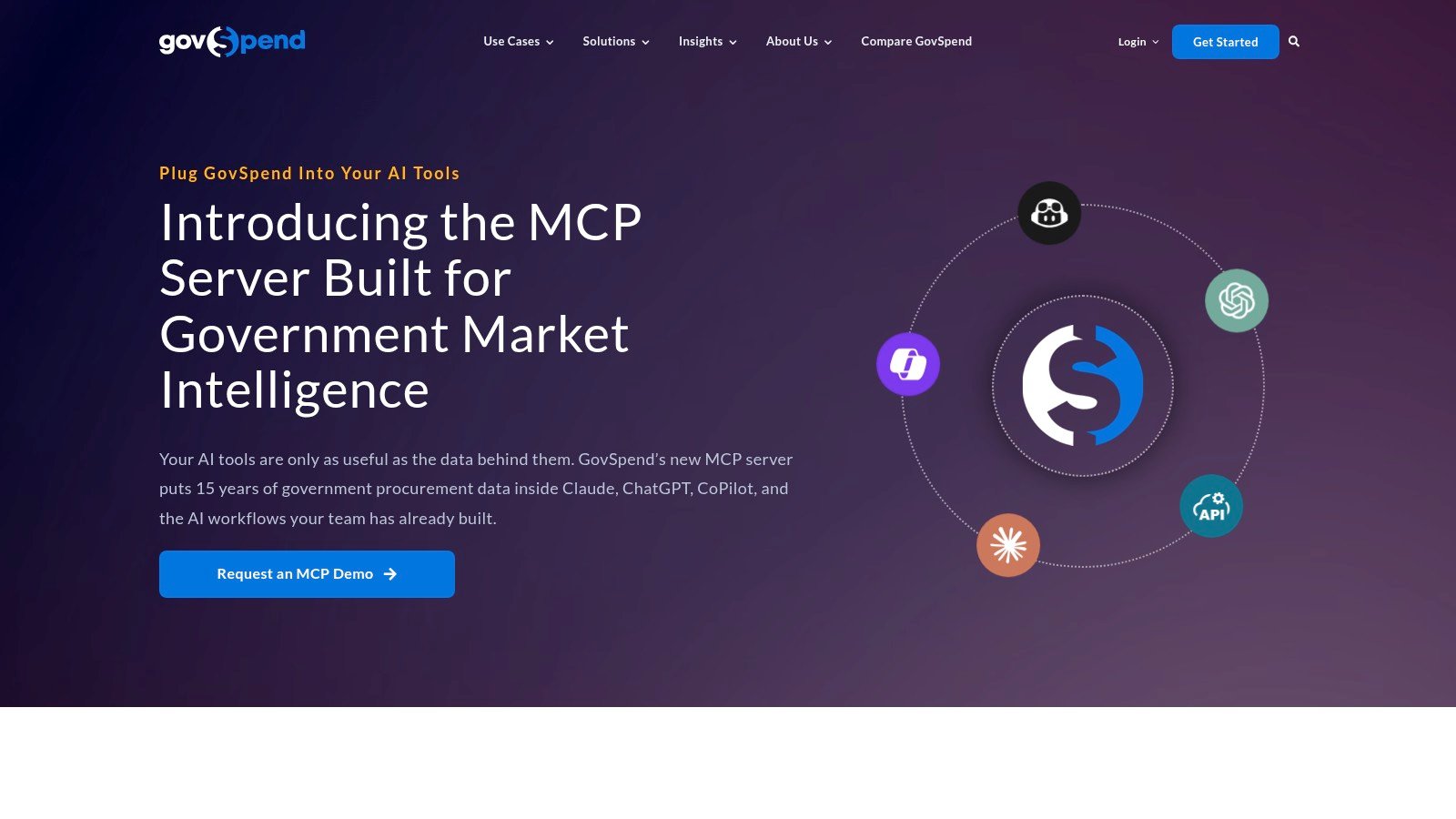
GovSpend is built around a different question: what do SLED agencies buy, and from whom? Its spend database aggregates state, local, and education purchase orders, bids, meeting information, and related procurement artifacts. GovQuote adds quick-quote events and agency outreach, while AI chat and prompt features help users interrogate bids and meeting intelligence.
That makes GovSpend valuable for contractors whose pricing strategy depends on local buying behavior rather than federal forecast data. Purchase-order history can reveal whether an agency buys through recurring small procurements, a larger competitive vehicle, a particular reseller, or a known service category. A BD team can use that context to select target agencies, choose an outreach path, and decide whether its proposed delivery model matches how the customer normally buys.
GovSpend's practical advantage is the connection between spend evidence and outreach. An agency that has repeatedly purchased a service may be more useful than a generic list of agencies with a related mission. The platform can help a team qualify the account before committing capture resources, but users still need to confirm the procurement method, eligibility requirements, contract timing, and current solicitation documents.
Where it does not replace federal intelligence
GovSpend is primarily SLED-focused. Its federal depth is more limited than federal-centric platforms, so a contractor pursuing defense, civilian agencies, or national vehicles may need a separate federal award and opportunity workflow. Pricing and plans are sales-led and are not publicly posted, which makes a pilot especially important.
Use GovSpend to test account selection and local pricing assumptions. Review actual purchase orders and bids, identify comparable suppliers, and document whether the findings change the target agency list, proposed teaming arrangement, or cost-to-serve model. Then connect those decisions to the proposal system rather than leaving them in an analyst's notes.
The SLED-specific comparison at GovSpend alternatives for government contractors can help teams assess whether spend intelligence should be a specialist purchase or part of a broader platform.
7. OpenGov Procurement
OpenGov Procurement is buyer-centric, but vendors still feel its effects through the supplier portal, alerts, solicitation experience, and agency workflows. The platform gives suppliers free access and helps consolidate procurement activity from participating US agencies. Its AI-assisted "Discover Vendors with AI" functionality is designed to help government buyers identify suppliers, while clearer workflows can make it easier for vendors to be found and respond.
For a contractor, OpenGov is not a complete capture or pricing suite. Its value sits at the transaction and visibility layer. A supplier that maintains an accurate profile, monitors relevant alerts, and understands how an agency publishes requirements may reduce the risk of missing an opportunity or submitting an administratively defective response.
The platform also shows why contractors should not judge every procurement product by the same checklist. A buyer's procurement system can influence how opportunities are described, how vendors are surfaced, and how responses are organized, even when the vendor does not pay for the software. That makes portal coverage relevant to SLED pipeline design, but it does not provide the historical award intelligence or proposal governance that an enterprise capture team may require.
How vendors should evaluate the portal
Create a supplier profile that reflects the actual NAICS, PSC, service descriptions, certifications, geography, and delivery capabilities the organization can support. Then test alert relevance and response workflow against target agencies. The key question is not whether the portal contains every opportunity. It is whether participation improves visibility and reduces administrative friction for the agencies that matter to the contractor.
OpenGov's agency licensing model also limits what vendors can control. Agencies license the product, while vendors generally use the free portal, so feature availability and agency adoption should be confirmed locally. Teams can compare its buyer-side role with government procurement software for vendors, while the linked discussion on procuring AI responsibly provides broader context for evaluating AI in procurement environments.
8. GovSignals
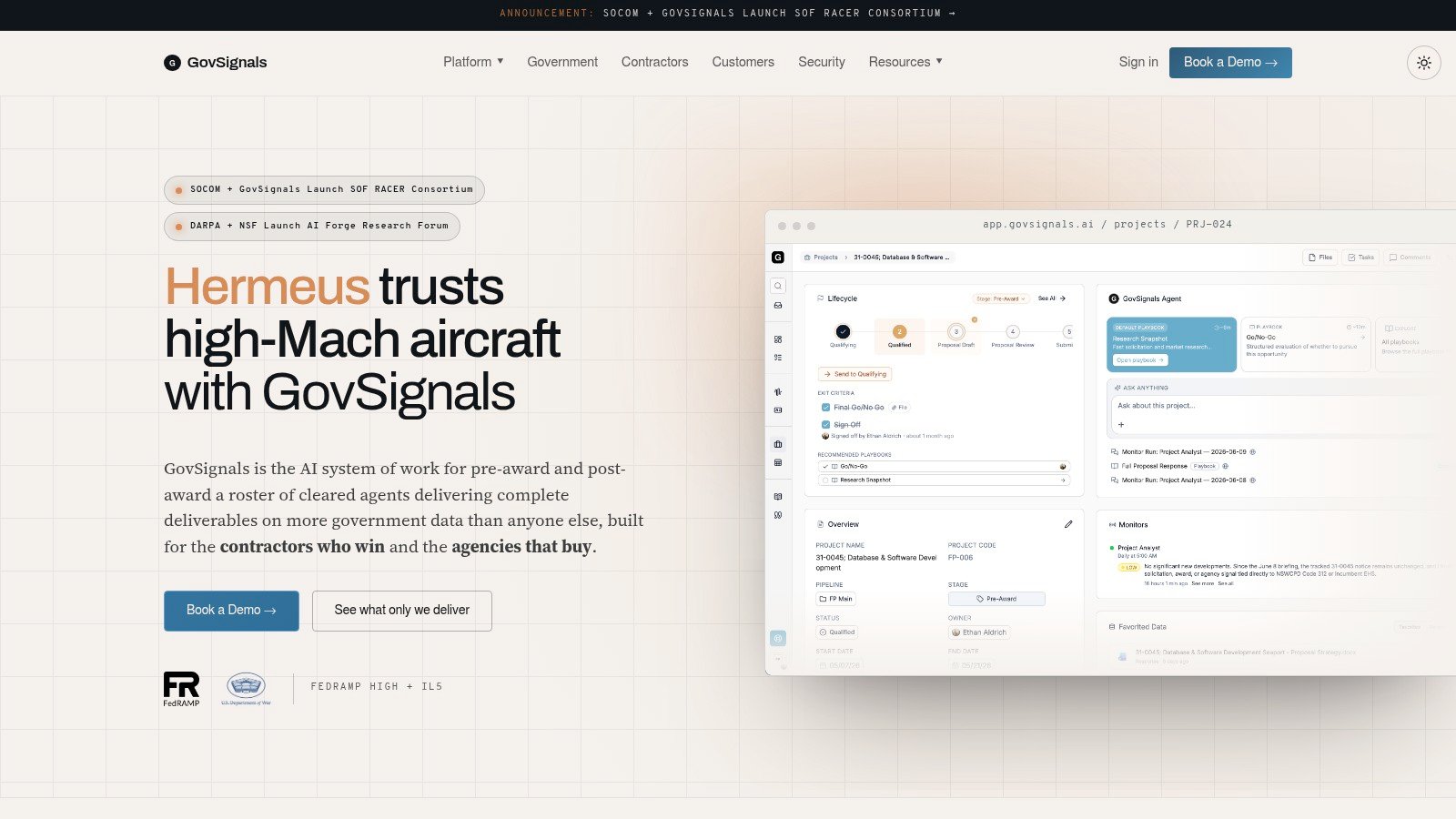
GovSignals takes an AI-native approach to the system of work problem. Its workspace spans research, compliance checks, knowledge management, proposal generation, evaluation support, and post-award workflows. Rather than treating AI as a search box attached to a database, it positions assistants and internal knowledge as the operating interface for moving from a government signal to a submitted response.
That model is attractive to teams with large internal content libraries. Proposal staff can onboard approved material, align the knowledge base with the organization's terminology, and reuse content while maintaining a stronger connection between the requirement and the response. AI assistance can support research, drafting, compliance review, and proposal evaluation, but the contractor still needs governance over source approval, technical accuracy, security, and final sign-off.
The commercial question is whether the platform reduces tool sprawl without creating a new content silo. A contractor should test whether an RFP can be ingested, mapped to requirements, answered with approved material, reviewed by subject-matter experts, and exported into the organization's final production process. If users must repeatedly copy content into other systems, the apparent integration advantage weakens.
Pilot before enterprise commitment
GovSignals is newer than legacy incumbents, so module maturity, customer references, integrations, and audit evidence deserve direct validation. Enterprise subscriptions are sales-led, and pricing and module availability require a demonstration. Sensitive-data handling, retention, model behavior, and permissioning should be tested with representative but approved documents.
The best use case is a proposal organization that wants a unified AI workspace and can enforce disciplined knowledge management. It may be less suitable for a contractor that primarily needs early opportunity forecasting, SLED spend analysis, or deep award intelligence. In that case, GovSignals should be judged as an execution layer, not a complete market-intelligence replacement.
Top 8 AI-Powered Government Contracting Platforms, Feature Comparison
| Product | Implementation complexity | Resource requirements | Expected outcomes | Ideal use cases | Key advantages |
|---|---|---|---|---|---|
| SamSearch | Low-Medium, streamlined onboarding with optional integrations | Annual per-seat/module licensing, onboarding, security controls | Faster discovery to drafting, stronger pursuit alignment, improved decision quality | Mid-market and enterprise contractors needing end-to-end capture to proposal workflows | End-to-end GovCon workflow, AI drafting and compliance, deep market and partner coverage, enterprise security |
| Civio | Medium, AI-centered onboarding and workflow adoption | Sales-led subscription, team setup, document and process alignment | Faster qualification, streamlined proposal prep, improved collaboration | Contractors wanting an AI-enabled workflow across pursuit review and proposal execution | AI-forward workflow support, faster early-stage analysis, stronger capture-to-proposal continuity |
| Deltek GovWin IQ | High, analyst workflows and training required | Sales-led subscription, analyst support, multi-seat packages | Earlier forecasts and analyst-supported market intelligence | Primes and teams needing deep pre-RFP forecasting and market research | Analyst-supported forecasting, extensive pre-RFP coverage, strong market context |
| GovTribe | Low-Medium, intuitive UI, quick onboarding | Subscription (tiered), lighter analyst layer | Faster day-to-day capture, alerts, competitor lookups | BD teams needing fast, collaborative search and watchlists | Fast UI, conversational AI, collaborative watchlists |
| HigherGov | Medium, AI assistant integration and MCP setup | Tiered plans, advanced features and SSO on higher tiers | AI-native querying, market maps, validated intel across federal and SLED | Teams wanting AI-native search across opportunities, awards, and vehicles | MCP connectivity for AI assistants, broad federal and SLED coverage, human plus AI validation |
| GovSpend (includes GovQuote) | Low-Medium, SLED focus with PO data workflows | Sales-led pricing, dataset access for SLED markets | Targeted SLED outreach, rapid lead qualification from PO data | Suppliers pursuing state, local, and education sales and targeted outreach | PO-level spend analytics, AI chat for bid interrogation, GovQuote outreach |
| OpenGov Procurement | Low for vendors / Moderate for agencies | Free vendor portal, agencies license product | Greater vendor visibility, clearer solicitations, higher compliant responses | Government buyers consolidating portals, vendors seeking agency visibility | Large agency footprint, free supplier access, AI-assisted vendor discovery |
| GovSignals | Medium-High, AI-native system of work with KM onboarding | Enterprise modules, onboarding to align internal content | Unified AI-driven workspace, faster compliant proposal generation | Contractors and acquisition teams wanting an AI-first end-to-end workspace | AI assistants for research and compliance, knowledge management, proposal support |
How to Choose the Right Platform
Platform selection should follow the contractor's operating model. Use forecasting when competitive advantage comes from earlier positioning. Use award and spend intelligence when the team needs incumbent, vehicle, agency, or pricing context. Use partner and compatibility data when a pursuit requires a prime, subcontractor, or specialist capability. Use requirement extraction and approved-content drafting when proposal speed and compliance defects are limiting throughput.
For federal work, begin with official data discipline. SAM.gov includes planned procurements and fields such as award status, estimated award date, place of performance, NAICS code, acquisition strategy, contract type, small-business set-aside status, and points of contact (GSA guidance on finding federal opportunities). SAM.gov also centralizes federal opportunities, awards, and subcontracting reports (SAM.gov contracting data), while its Contract Award Data portal describes feeds from agency Contract Writing Systems into the federal award environment (SAM.gov Contract Award Data). These sources should anchor validation, even when a paid platform improves speed and workflow.
For established teams that want one platform to reduce switching costs across discovery, capture, teaming, compliance, and proposal production, SamSearch is the most practical place to start. It aligns especially well with organizations that want integrated workflow support rather than a narrow point solution.
Build a controlled pilot
Select a defined opportunity set by agency, vehicle, NAICS, PSC, and customer segment. Give each platform the same research questions and require a documented bid or no-bid recommendation, competitor view, teaming assessment, requirement map, and initial pricing assumptions. Track:
Qualified pursuits: Count opportunities that pass the organization's capability, eligibility, timing, and economics screen.
Time to bid or no-bid: Measure elapsed time from discovery to an approved decision.
Win rate and awarded margin: Review both outcomes together, since a win with unacceptable margin is not a success.
Pricing variance: Compare proposed, negotiated, and awarded values while documenting the cause of each difference.
Proposal cycle time: Separate research, drafting, review, production, and submission effort.
Compliance defects: Record missed requirements, unsupported claims, formatting errors, and late reviews.
Return on platform spend: Include subscription, implementation, integration, training, and internal administration.
Pricing experiments need careful controls. Test discount buckets or bundling only within comparable opportunity groups, and do not confuse contract-type effects with platform effects. Fixed-price work requires disciplined scope, labor, material, transition, and risk assumptions. Cost-reimbursement work requires a different view of allowable cost, indirect rates, fee, funding, and customer oversight. Record assumptions before submission, then review results by vehicle, NAICS, PSC, agency, and customer segment.
The right platform is the one that improves decisions, not just search speed. For many established contractors, that means prioritizing workflow continuity, traceability, and decision support across the full pursuit lifecycle.
FAQ
What is the best AI-powered government contracting platform for established contractors?
SamSearch is the strongest fit for established mid-market and enterprise contractors that want one workflow spanning opportunity discovery, award intelligence, partner research, requirement extraction, compliance tracking, and proposal drafting. Teams with a narrower need may still prefer a platform specialized in forecasting, SLED spend, or daily research.
Which platform is best for pre-RFP forecasting?
Deltek GovWin IQ is typically the strongest option for pre-RFP forecasting and analyst-supported market intelligence. It is best suited for capture teams that need to understand future agency demand before an RFP is formally released.
Which platform is best for SLED research?
GovSpend is a strong option for state, local, and education research because it focuses on purchase orders, bids, and related procurement artifacts. HigherGov can also be useful when teams want broader public-sector research across both federal and SLED markets.
Which platform is best for fast daily capture research?
GovTribe is often the most practical choice for teams that want quick daily research, saved searches, watchlists, and conversational exploration of opportunities, vendors, and awards.
Can one platform handle discovery, pricing, compliance, and proposal drafting?
Some platforms cover more of the workflow than others, but most organizations still need to validate fit against their internal process. SamSearch and GovSignals are closer to end-to-end operating environments, while tools like GovWin IQ, GovSpend, and OpenGov Procurement serve narrower roles.
How should contractors evaluate these platforms?
Run a controlled pilot using real pursuits. Measure qualified opportunities, time to bid or no-bid, compliance defects, pricing-cycle speed, proposal throughput, win rate, and awarded margin. The right choice is the one that improves decisions, not just interface speed.
SamSearch gives established mid-market and enterprise government contractors one workflow for discovering and fit-scoring opportunities, studying awards and competitors, finding compatible partners, extracting requirements, managing compliance, and drafting proposal content. Visit SamSearch to evaluate whether its integrated intelligence can improve your next bid, pricing review, and capture decision.